

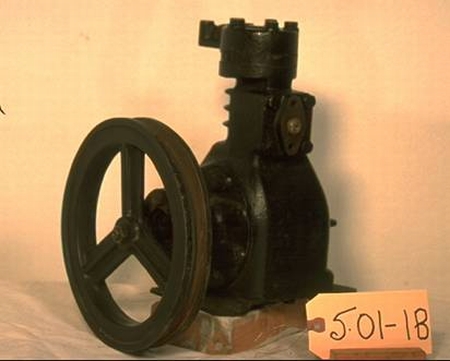
Refrigerating and Air Conditioning Compressors – Household
By the early 1930’s the Canadian refrigeration industry was moving beyond its embryonic years into a period of early development. Compressors were becoming much more “domesticated” in appearance, as pioneer manufacturers, such as Kelvinator, moved confidently into what appeared to be a promising, growing market. The Kelvinator Model A, still faster and smaller, would help to move the cabinet refrigerator into middle class and working Canadian homes [see #003], well beyond the exclusive realm of the country’s elite, Kelvinator 1932.
Technical Significance:
This single cylinder, reciprocating compressor, of similar but significantly more advanced engineering than 5 years earlier, was small and high speed, by comparison [fly wheel diameter was reduced by Kelvinator from 14″ to 8.5″] and much quieter in operationBy now condensing units were also smaller, much more polished in appearance, and routinely designed for inclusion in the base of the household cabinet refrigerator. Although many would still be “remoted” in the basement by the local refrigeration mechanic.
Substantial manufacturing facilities came to maturity in this period to supply the specialized developmental needs of firms such as Kelvinator and Frigidaire. A significant new industrial sector had been born, patterned after the exploding automobile industry of the times.
These were the years, too, of the birth of the refrigeration trade in Canada. Manufacturers were dependent on informed and trained workers for installation and providing the all to frequent service needed – and knew it.
The reciprocating compressor, its engineering challenges not-with-standing, would remain largely the standard of the industry throughout the 20th century, although alternative rotary designs would appear on the market and be sustained for brief periods, from time to time.
Industrial Significance:
While designed for sulphur dioxide these compressors, built with amazing precision and to close tolerances for the period, would see life over the next 20 years and more, on refrigeration machines converted to new chlorinated hydrocarbon refrigerants. The Model A would be a standard of the industry up to the late 1930’s and the advent of the sealed, “hermetic” motor compressor