

Pressure Atomizing Oil Burner Equipment and Systems – Ignition Transformers
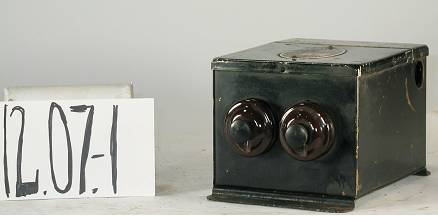
An 8,000 volt, electric spark, ignition transformers, in gloss black steel case with brass nameplate. Such devices in the home and the sparks they generated would be a source of great public mystery and often apprehension in the early years of the 20th century. Yet, they would be the true heroes of early technology for the Canadian home; without them the mechanical wonders of the period would not have been possible, the internal combustion engine, the automobile, and automatic home heating. Webster, Circa 1936.
Features: Original wire connector illustrating electrical trade practices of the times
Chrome plated cameo styled, brass nameplate, highly decorate with logo.
Technical Significance:
In a period of increasingly sophisticated mechanical contrivances, the development of electrical apparatus – including reliable, efficient high voltage ignition transformers and electric motors tended, for the most part, to lag well behind the mechanical mechanisms which they supported.
The engineering and manufacturing challenge was to build an electrical transformer, to operate on 110 volts alternating current [the then accepted standard for hydro electrification in Canada], one that would create a sufficiently hot spark, about 8,000 to 10,000 volts, needed to reliably ignite an atomised oil vapor and air mixture.
Little of a theoretical practical nature was known in the early years of the 20th century about the design of electrical equipment, certainly not high voltage transformers. The principles of alternating electrical circuits, as well as those of magnetic circuits were little understood, by those who must apply them.
Farada’s experiments of the 1840’s and 50 had only been translated into the mathematical formula needed for precise engineering design in the 1870’s. And Steinmetz would not set out the basic parameters for the design of electromagnetic circuits until the early years of the 20th century. But the market place could not wait, engineering design proceeded empirically, with the knowledge available – with much trial and error.
The toe crushing weight and size of these early specimens [15 to 20 lbs] is a reminder of the crude design criteria employed and the materials available, especially the crude dielectric materials for the insulation of wire and coil bundles operating at high potential levels. As a result electrical failure was common, with all the accompanying dangers of un-ignited explosive mixtures being pumped into the furnace fire box.
Of special significance is this, long obsolete, 25 cycle, AC specimen. Once the standard in Ontario, 25 cycle equipment was heavier and bulkier than its 60 cycle counter part.
Industrial Significance:
By the mid 1930’s the future of the Canadian oil heat industry was assured of a long period of solid growth. With hydro electrification now well advanced in many urban areas in Canada, the desire for automatic, home heating was almost universal, and with it the pressure to engineer high voltage ignition devices in Canada, at reduced cost and improved reliability and performance – See ID# 256 and 257.