

Electric Motors – Single Phase, Repulsion Induction and Repulsion Motors
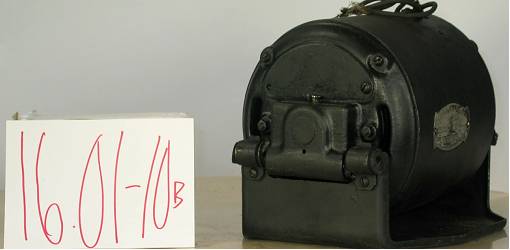
An early 20th century, 25 cycle, repulsion induction motor for household cabinet refrigerator with vibration isolating motor mounts, and fusetron holder, two significant innovations, helping to reduce noise in the kitchen, and the risk of property and personal injury due to motor overheating, Delco, Circa 1934. [see also ID# 298, 301]
Features:
– Early 4 point, innovative, vibration isolating motor mounts
– Fusetron holder now blanked off, early technology for motor overload protection
Technical Significance:
– Represented here are two major innovations in FHP motor technology for the Canadian home, associated with the early 1930’s. One for the reduction of noise [the four-point vibration, rubber mount], the second for reduction of risk of property and personal damage, due to an overheated motor [the fusetron]. Both were crude beginnings, soon to be replaced by more advanced forms of the technology.
– The fusetron [See item code 16.06-5], now removed and opening blanked off, tells important stories of technological evolution and advancement in personal and property protection. The fusetron was a slow blow fuse engineered to take the high starting current associated with inductive loads, but to open circuit in response to prolonged over load conditions. Lacking a recycling capability, it left the homeowner vulnerable. As a consequence many homeowners would find their refrigerator off, with resultant food spoilage. The inherent motor overload protector with an automatic recycling capability would still be another decade in the making. In the meantime many fusetrons were disabled by local refrigeration service technician, on the request of angry homeowners. [see ID#294 for example of “Klixon” inherent, automatic overload protection, and ID# 303 for example of early protector by Wagner]
– Repulsion induction motor technology was above all a marvel of its time, a technology born of both science and the consumer market place, a classic formula for the innovation and diffusion of popular technology, throughout the balance of the 20th century and on in to the 21st. Scientifically, the work of Faraday and many others laid much of the theoretical foundations for electromagnetic devices, the marvel of the early 20th century [much in the same way digital devices became the marvel of the early years of the 21st]. The wonders made possible by alternating current energised, rotating magnetic fields and the electric and magnetic circuitry that made them possible would soon be exploited by those interested in their application in applied electro-motive technology, including Steinnmetz and others. [See References especially #I, 2, and 5]
– See also ID# 296
Industrial Significance:
– See also notes ID# 296