

Pressure Atomizing Oil Burner Equipment and Systems – Firing Assemblies
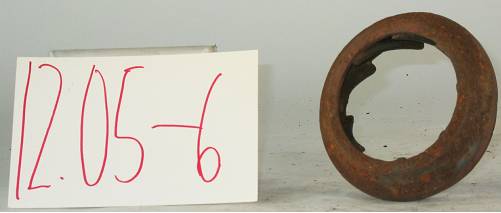
An air cone for a high pressure, atomizing oil burner, designed with convex nose and 8 turbulator blades. Unobtrusive and elemental in appearance and seemingly of little consequence, it would, none-the-less, prove to be a critical component in oil burner performance in its time, helping to ensure quiet, efficient, smoke free combustion. \r\nBlued and heavily corroded as a result of use in a typical 3000 deg. combustion chamber, unknown manufacturer, Circa 1948. [see also ID#265]
Technical Significance:
The simple, crude air cone, a piece of sand moulded and machined cast iron, would come to represent much of the challenge faced in squeezing acceptable levels of reliable performance out of the high pressure atomizing oil burner, given the state of that technology in the early and mid 20th century.
In this period, experiments in refractory, air cone, air turbulator, nozzle, electrode and oil pump design would be endless, in an attempt to optimize a technology which refused to be optimized, until significant redesign and re-configuring of the high pressure atomizing burner took place in the latter years of the century. [See Reference 1]
This seemingly simple, elemental device stands as a reminder of the system of often crudely fashioned, empirically derived, interrelated and mutually supporting component parts on which the safe, reliable and efficient operation of automatic oil heating for the Canadian home would depend in the mid 20th century.
Industrial Significance:
Many variations in air cone design are to be found, reflecting the practice of the period. Each manufacturer would experiment to find the configuration best suited to his equipment’s performance – see ID#265