

Solid Fuel (Coal and Wood) Burning Equipment – Other Components and Parts
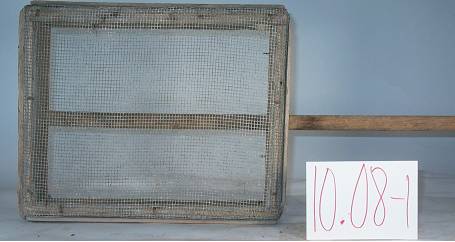
A late 19th century, home made, manually operated ash sifter, roughly hewn, nailed together of old boards found around the home, with broom stick, shaker handle and 1/8 inch galvanized screening, etched and eroded through the effects of prolonged use, in sifting ash so as to reuse the unburned, and partially burned pieces of coal, a simple made at home energy conservation technology, Circa 1898.
Technical Significance:
The hand operated ash sifter is an example of a “small”, “appropriate” Canadian technology of its time, responding to the social, cultural and economic needs and constraints of the period.
The ash sifter was an early energy conservation device, used to conserve a scarce costly energy resource, coal
Energy conservation would be a re-occurring theme in the residential home heating sector, one which would be echoed into and throughout the 20th century and on into the 21st. A news letter to Fess Oil Burner of Canada dealers in 1947, responded to the energy shortage of that period, advising the home owner and service technician of their shared responsibilities for energy conservation, this time in the conservation of home heating fuel oil [see note #2]
A simple handcrafted tool, a made at home technology, the hand operated ash sifter was invented as a response to needs at the turn of the 20st century, would be strangely anticipatory of the needs 100 years later at the turn of the 21st century. The issue then as now is one of energy conservation, a reoccurring theme, marking the “scarcity”, “availability”, as well as “market price” [affordability].
The hand operated manual ash sifter would find its place in the large homes at the turn of the 20th century many of which were heated, at least in part, by coal fired fireplaces, without the luxury of built in shaking mechanisms
The shaking of ashes manually by a hand sifter technology would be a fact of life for those with coal burning fireplaces. For those with central coal heating furnaces with built in shaker grates [operated by turning of a crank], it would be a backup to retain the un-spent coal that escaped the mechanised sifting process.
Industrial Significance:
Crudely fabricated of old pieces of wood, found around the home, clearly the largely unskilled work of a homeowner or household handyman, it is rare marker of the days well before technology’s invasion of the Canadian home, with endless line of labor saving tools, appliances and products for comfort, safety, health and convenience.
The finely made 1/8th inch galvinized sifter screen appears to be a bit of an anomaly, standing in sharp contrast to the other found-at-home materials used. The screening appears not to have been a later addition, however, given the integrated construction detail. All of which says something about the relatively advanced processes for the production of galvanized coated screen of the period – anachronistic