

Refrigerating and Air Conditioning Pressure and Temperature Controls – Household
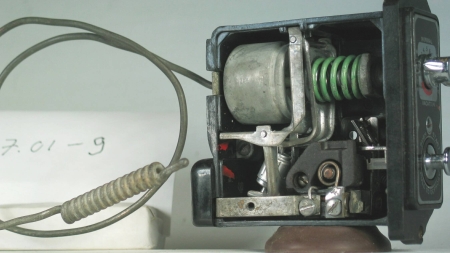
An hydraulic bellows actuated, automatic temperature controls, employing extended capillary tube sensing, with compact internally enclosed bellows and an unusual twisted capillary tube bulb configuration, equipped with manual reset, electric motor overload protection, featuring popout, motor lock-out switch, with high polished chrome bezel, decorated in black and red, with chrome control knobs, enclosed in beautifully moulded, gloss black, Bakelite case, with hand written identification tag, Cutler – Hammer, circa 1937.
One of a series of early, hydraulic bellows actuated, automatic temperature controls, employing extended capillary tube sensing – the preferred sensing technology of the mid 20th century. [See items ID # 142- 151]. The genre would give way by the end of the century to electronic sensing methods.
Technical Significance:
The series [see items ID # 142- 151] profiles the evolution of extended capillary tube technology through a myriad engineering design developments and applications. It was a period driven by, and responding to, a new often shameless, marketing hyperbola. For the industry would take full advantage of knowledge from the newly found thermal and fluid flow sciences of the times, as well as of the new materials technology and manufacturing methods of the immediate pre-W.W.II years.
The industry was clearly out to create ever-increasing consumer interest and expectations for a user friendly, fully automated, self-regulating, affordable, mechanically driven cabinet refrigerators for the Canadian home. It was “an automatic refrigerator in every kitchen” following the marketing pattern set by the automobile industry for “an automobile in every garage”, that was the call of the captains of the household refrigeration industry. The perfection of a reliable, affordable, and user friendly, automatic temperature control was critical to the success of this business venture.
The Cutler-Hammer Co. of Milwaukee Ill., had made its name in the electrical switching business in the 1930’s was encouraged to enter the automatic temperature control field in this period of rapidly developing pre W.W.II consumer markets. The sophisticated engineering and manufacturing capacity developed by the company as evident here is impressive
The high polished chrome fitments illustrate the increasing emphasis placed on appealing industrial design, and well crafted and finished products in gaining a toehold in what was becoming an increasingly crowded field of consumer equipment manufacturing and production.