

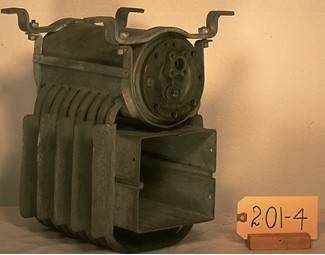
Refrigerating and Air Conditioning Evaporators – Household
The technological significance of the evaporator in a mechanical refrigeration system lies in its ability to evaporate liquid refrigerant (allowing it to absorb latent heat and thus perform useful cooling). In the public mind, however, the useful work was more simply that of cooling. This lead astute manufactures to popularise the use of the term “cooling unit” in place of evaporator. It was the term adopted by the industry in the early years, as it attempted to connect with the human experience of the times to better promote its wares, gaining market share in the embryonic years of Canada’s emerging consumer society. (See examples in early sale literature from the Kelvinator Co. of Canada)
Human experience and the social culture of the 1920’s also associated useful cooling with the melting of ice. Historically manufactures successfully played to this sense of public understanding by further marketing cooling units as icemakers. By this means they appealed to wide spread cultural understandings of how things got cooled, through the controlled melting of ice (the popular Canadian icebox of the 1920’s and 30’s). In a peculiar twist, it was often the job of the refrigeration sales or service man to explain to the homemaker that it was not really the ice in the ice cube trays that cooled the refrigerator, but the motor and compressor underneath.
In the 1920’s manufactures of mechanical refrigerators for the home appealed to the consumer public by promoting ice and ice cream as the new consumables, the new food sensations available for all those sufficiently affluent to enjoy the experience. Promotional literature focused on the pleasant sensation of ice cold beverages and on ice cream making at home – using the latest cooling unit. A recipe and food life style book came with the refrigerator for the edification and instruction of the homemaker (See examples in early sale literature from the Kelvinator Co. of Canada). Ice and ice cream making in the home was, in fact, one of the significant, new “Gee whiz”, household technologies of the times.
This specimen is a particularly early, a well-preserved sample of cooling unit art form (Frigidaire shows this evaporator as discontinued May 5, 1928). Crude in manufacturing techniques, by subsequent standards, the industry would move quickly to modernise the look of its products and to develop the materials and manufacturing processes needed to produce them. (See for example items 011 and 012)